
Table of Contents
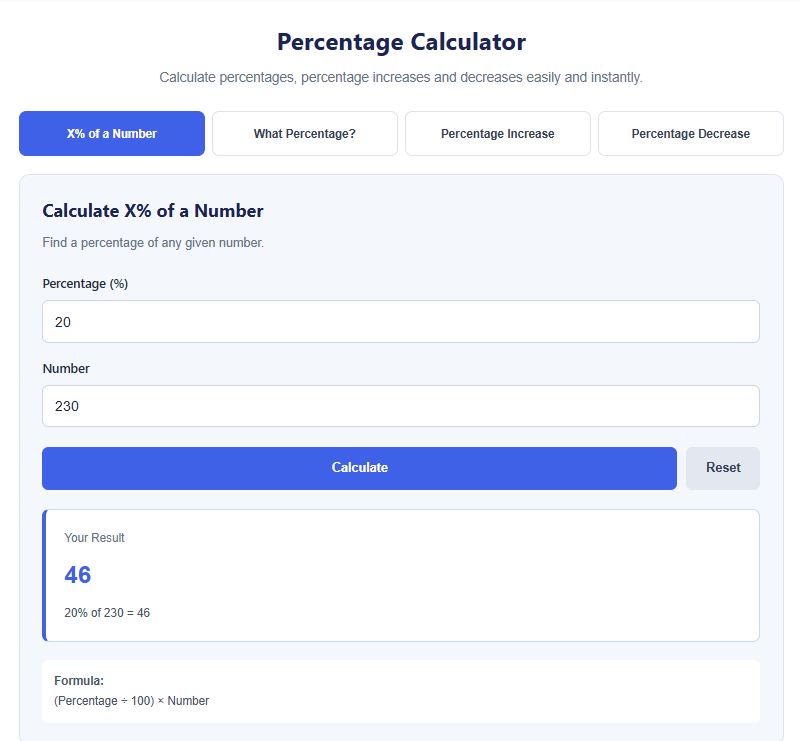
Percentage Calculator
Calculate percentages, percentage increases and decreases easily and instantly.
Calculate X% of a Number
Find a percentage of any given number.
(Percentage ÷ 100) × Number
What Percentage Is X of Y?
Find out what percentage one number represents of another.
(Part ÷ Total) × 100
Percentage Increase Calculator
Calculate the percentage increase between two values.
((New Value – Original Value) ÷ Original Value) × 100
Percentage Decrease Calculator
Calculate the percentage decrease between two values.
((Original Value – New Value) ÷ Original Value) × 100
Percentage Calculator: Definition, Formulas, Examples and Online Calculation
Percentage calculations are widely used in everyday life. Whether you want to calculate a discount during a sale, determine a salary increase, find the proportion of a value, or calculate a price reduction, percentages make it easier to compare quantities.
With our free online percentage calculator, you can quickly perform different types of calculations without having to memorize mathematical formulas. Simply enter the required values to get your result instantly.
In this article, discover the definition of a percentage, essential formulas, practical examples, and common mistakes to avoid.
What Is a Percentage?
A percentage is a way of expressing a proportion or quantity in relation to 100. The symbol used to represent it is %.
The word “percentage” literally means “per hundred.” Therefore:
- 10% means 10 out of 100.
- 25% means 25 out of 100.
- 50% means 50 out of 100.
- 100% represents the entire quantity.
A percentage can also be expressed as a fraction or a decimal number.
| Percentage | Fraction | Decimal |
|---|---|---|
| 10% | 10/100 | 0.10 |
| 25% | 25/100 | 0.25 |
| 50% | 50/100 | 0.50 |
| 75% | 75/100 | 0.75 |
| 100% | 100/100 | 1 |
| 150% | 150/100 | 1.50 |
Example: If a class has 40 students and 25% are girls, this means that 25 out of every 100 students would be girls in an equivalent proportion. To find the actual number of girls, calculate 25% of 40.
40\times\frac{25}{100}=10Therefore, there are 10 girls in the class.
How to Calculate a Percentage
To calculate a percentage, you generally multiply the value by the percentage rate and then divide the result by 100.
The general formula is:
\boxed{P=\frac{A\times T}{100}}Where:
- P represents the result;
- A represents the original value;
- T represents the percentage rate.
Example:
Calculate 20% of 500
P=\frac{500\times20}{100}P=100
Therefore, 20% of 500 is equal to 100.
Different Types of Percentage Calculations
There are several common percentage calculations. Our online calculator allows you to perform the following four types of calculations.
How to Calculate X% of a Number
This calculation helps you determine a portion of a total value.
Formula:
Result=\frac{Number\times Percentage}{100}Example: Calculate 15% of 800
\frac{800\times15}{100}=120Result: 120
This means that 15% of 800 is equal to 120.
More examples:
- 10% of 200 = 20
- 25% of 400 = 100
- 30% of 150 = 45
- 50% of 1,000 = 500
How to Calculate What Percentage One Number Is of Another
This calculation helps you determine the proportion of one value compared to a total value.
Formula:
T=\frac{Part}{Total}\times100Example: A student scores 36 points out of a total of 45 points. What is the percentage score?
T=\frac{36}{45}\times100T=80\%
Result: 80%
The student has achieved 80% of the total score.
How to Calculate a Percentage Increase
A percentage increase measures how much a value has increased between two situations.
Percentage increase formula:
T=\frac{Final\ Value-Initial\ Value}{Initial\ Value}\times100Example: The price of a product increases from 200 to 250. What is the percentage increase?
T=\frac{250-200}{200}\times100T=25\%
Result: 25%
The product price has increased by 25%.
How to calculate the new value after an increase
To increase an initial value by a given percentage, use:
Final\ Value=Initial\ Value\times(1+\frac{T}{100})For example, to increase 200 by 25%:
200\times(1+\frac{25}{100})=250 The new value is 250.
How to Calculate a Percentage Decrease
A percentage decrease measures how much a value has decreased compared to its initial value.
Percentage decrease formula:
T=\frac{Initial\ Value-Final\ Value}{Initial\ Value}\times100Example: An item initially costs 500. After a discount, its price drops to 400. What is the percentage discount?
T=\frac{500-400}{500}\times100T=20\%
Result: 20%
The discount applied is therefore 20%.
How to calculate the new value after a decrease
Final\ Value=Initial\ Value\times(1-\frac{T}{100})To decrease 500 by 20%:
500\times(1-\frac{20}{100})=400The new value is 400.
Percentage Formula Summary Table
Here are the main formulas you should remember to perform percentage calculations quickly.
| Type of calculation | Formula |
|---|---|
| Calculate X% of a number | Number × Percentage / 100 |
| Find a percentage | Part / Total × 100 |
| Calculate a percentage increase | (Final − Initial) / Initial × 100 |
| Calculate a percentage decrease | (Initial − Final) / Initial × 100 |
| Value after an increase | Initial × (1 + T/100) |
| Value after a decrease | Initial × (1 − T/100) |
Practical Examples of Percentage Calculations in Everyday Life
Percentages are used in many everyday situations. Here are some practical examples to help you understand how they work.
Example 1: Calculate a Discount During a Sale
A store offers a 30% discount on an item originally priced at 700.
Step 1: Calculate the discount amount.
\frac{700\times30}{100}=210Step 2: Calculate the price after the discount.
700-210=490
The discount amount is 210, and the final price is 490.
Example 2: Calculate a Salary Increase
An employee earns a monthly salary of 8,000. Their employer grants them a 5% salary increase.
\frac{8000\times5}{100}=400The salary increase amounts to 400.
8000+400=8400
The new monthly salary is 8,400.
Example 3: Calculate a Pass Rate
A candidate answers 42 questions correctly out of 60.
\frac{42}{60}\times100=70\%Their success rate is 70%.
Example 4: Calculate 20% VAT
A product costs 1,000 before tax. The VAT rate is 20%.
VAT=\frac{1000\times20}{100}=200The VAT amount is 200.
Total\ Price=1000+200=1200
The total price including VAT is 1,200.
How to Use Our Online Percentage Calculator
Our free application allows you to perform common percentage calculations easily. It works on computers, tablets, and smartphones.
Follow these steps to use the calculator:
1. Open the application displayed on this page.
2. Select the type of calculation you want to perform.
3. Enter the required values in the appropriate fields.
4. Run the calculation.
5. View the result displayed instantly.
The application offers four main features:
- Calculate X% of a number: Find a percentage of a given value.
- Find what percentage X is of Y: Determine the proportion of one number compared to another.
- Calculate a percentage increase: Find the percentage increase in a value.
- Calculate a percentage decrease: Calculate a reduction or decrease in a value.
The result is calculated automatically, without requiring you to perform the mathematical operations manually.
What Is the Difference Between a Percentage and a Percentage Point?
It is important not to confuse a percentage with a percentage point.
A percentage point represents the direct difference between two rates expressed as percentages.
Example: A pass rate increases from 60% to 70%.
- The increase is 10 percentage points.
- The relative percentage increase is:
\frac{70-60}{60}\times100=16.67\%Therefore, the rate has increased by 10 percentage points, which represents a relative increase of approximately 16.67%.
Common Mistakes When Calculating Percentages
Although percentage calculations are relatively simple, some mistakes are common.
Mistake 1: Forgetting to divide by 100
To calculate 20% of 300, you must perform:
\frac{300\times20}{100}=60The result is not 6,000 because you must divide by 100.
Mistake 2: Using the wrong reference value
When calculating a percentage increase or decrease, the initial value must be used as the reference in the denominator.
Mistake 3: Confusing an increase with a decrease
A 20% increase and a 20% decrease do not produce the same result when applied successively.
For example, a price of 100 increased by 20% becomes 120. If this new price is then decreased by 20%, it becomes:
120\times0.80=96
The final price is 96, not 100.
Mistake 4: Simply adding successive percentages
Two successive 10% discounts do not equal a total discount of 20%.
For an item initially priced at 100:
- After the first 10% discount: 90.
- After the second 10% discount: 81.
- The total discount is therefore 19%.
Frequently Asked Questions About Percentages
How Do You Quickly Calculate 10% of a Number?
To calculate 10% of a number, simply divide it by 10.
Example: 10% of 350 = 35.
How Do You Calculate 20% of an Amount?
Multiply the amount by 20, then divide the result by 100.
Example: 20% of 500 = 100.
How Do You Calculate 50% of an Amount?
50% represents half of a value. Simply divide the amount by two.
Example: 50% of 800 = 400.
How Do You Calculate a Percentage Using a Calculator?
To calculate a percentage, multiply the value by the percentage rate and divide the result by 100.
Example: 15% of 200 = 200 × 15 ÷ 100 = 30.
How Do You Find the Original Price After a Discount?
Divide the discounted price by the remaining percentage expressed as a decimal.
For example, after a 20% discount, an item costs 80:
Original\ Price=\frac{80}{1-0.20}=100The original price was 100.
How Do You Calculate the Percentage Difference Between Two Numbers?
To calculate the percentage change between two values, use the following formula:
\frac{Final\ Value-Initial\ Value}{Initial\ Value}\times100A positive result indicates an increase, while a negative result indicates a decrease.
Is the Online Percentage Calculator Free?
Yes. Our online percentage calculator is completely free and does not require registration. It allows you to perform several types of percentage calculations quickly.
Conclusion
Percentages are an essential mathematical tool for comparing values, calculating discounts, determining increases, and analyzing proportions. Understanding their formulas makes it easier to solve many problems encountered in education, business, and everyday life.
To save time and avoid calculation errors, use our free online percentage calculator. It provides quick and accurate results and makes percentage calculations simple.
You may also like :
Explore more topics
Percentage Calculator: Definition, Formulas, Examples and Online Calculation
Percentage Calculator: Definition, Formulas, Examples and Online Calculation
Percentage Calculator: Definition, Formulas, Examples and Online Calculation
Percentage Calculator: Definition, Formulas, Examples and Online Calculation
Percentage Calculator: Definition, Formulas, Examples and Online Calculation
Percentage Calculator: Definition, Formulas, Examples and Online Calculation
Percentage Calculator: Definition, Formulas, Examples and Online Calculation
Percentage Calculator: Definition, Formulas, Examples and Online Calculation
Percentage Calculator: Definition, Formulas, Examples and Online Calculation
Percentage Calculator: Definition, Formulas, Examples and Online Calculation