Table of Contents
Ideal Gas Law Calculator (PV=nRT)
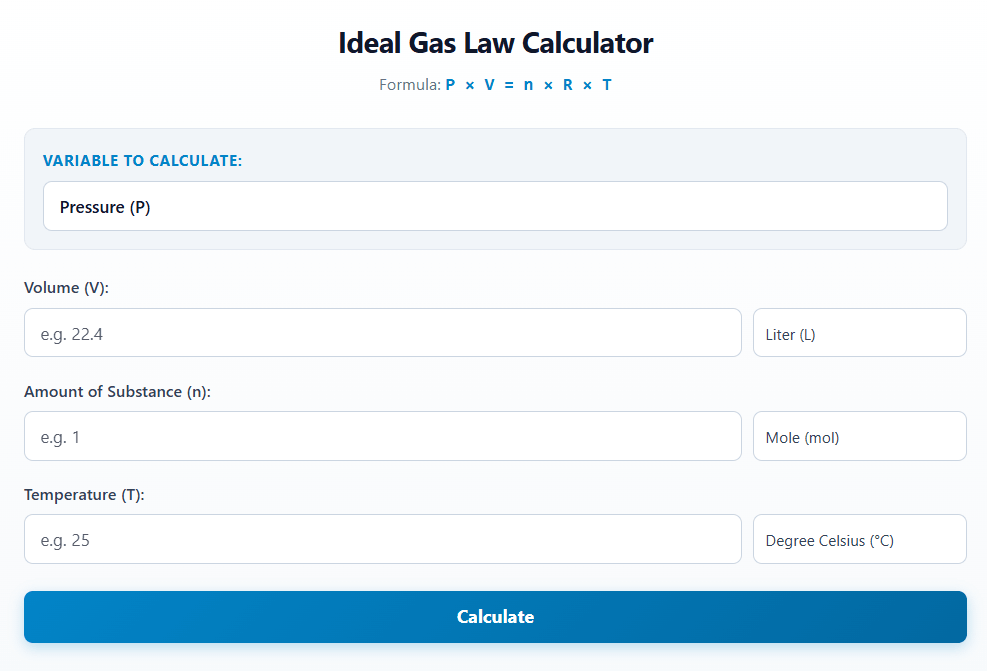
Ideal Gas Law Calculator
Formula: P × V = n × R × T
What is an ideal gas?
The ideal gas model is defined based on several assumptions:
An ideal gas consists of molecules that can be modeled as hard spheres whose diameter is negligible compared to the average distance between them. Likewise, the molecules do not interact with each other, and collisions between molecules (as well as between molecules and the container walls) are assumed to be elastic.
Characteristics of Gases
- Gases take on the volume and shape of their containers
- Gases are compressible, whereas liquids and solids are virtually incompressible
- Gases released into the same container mix uniformly and completely
- Gases have densities that are significantly lower than those of liquids and solids
Ideal Gas Equation of State – Ideal Gas Law
The macroscopic quantities that describe an ideal gas in thermodynamic equilibrium satisfy the relationship:

Where:
- P: the pressure of the gas, expressed in pascals (symbol Pa).
- n : the amount of substance in moles (symbol mol).
- V : the volume of the gas in cubic meters (symbol m3).
- T : the thermodynamic temperature in kelvins (symbol K).
- R : called the ideal gas constant, is equal to 8.314 joules per kelvin per mole: R = 8.314 J.K-1.mol-1.
Note: To convert a temperature θ in degrees Celsius to a temperature T in kelvins, simply add 273.15 (or 273.13 as in your reference):

Example
What is the volume V occupied by one mole of air at 0°C and atmospheric pressure P = 1.013 ×10⁵?
- Write down the ideal gas law: P⋅V=n⋅R⋅T
- Isolate the parameter we are solving for (V):

- Identify the known values : n=1mol , P=1.013×10⁵ Pa , and R=8.314 J⋅mol-1⋅K-1.
- Convert temperature to Kelvins: T=θ+273.13=0+273.13=273.13K
- Calculate the volume occupied by the gas

- Since 1 m3=1000L , then V=2.24×10⁻² m3=2.24×10-2×1000L=22.4L . This is the molar volume.